

Running shoes do not last forever. Even if the upper still looks good, the cushioning, support, and outsole can gradually wear down with regular use.
So, how long do running shoes last? A common guideline is around 300 to 500 miles (480 to 800 km), but the actual lifespan depends on the shoe, your body weight, running style, surface, frequency of use, and how well you maintain your shoes.
If you are wondering whether your running shoes still have enough life left in them, there are several signs that can help you decide.
How Long Do Running Shoes Usually Last?
Most running shoes can last roughly 480 to 800 km before they may need replacing.
However, mileage is only a guideline. Two people can use the same pair of running shoes and get very different lifespans from them.
For example, someone who runs several times a week on rough roads may wear out their shoes faster than someone who uses the same shoes occasionally on a treadmill.
Your running shoes may also need replacing sooner if you use them for other activities such as walking, gym workouts, or everyday commuting.
What Affects the Lifespan of Running Shoes?
Several factors can affect how quickly running shoes wear out:
- How often you run
- The distance you run each week
- Your running style
- Your body weight
- The type of surface you run on
- The shoe’s cushioning and materials
- How you store and clean the shoes
- Whether you use them only for running or for everyday activities too
This means there is no single replacement date that works for everyone.
7 Signs It’s Time to Replace Your Running Shoes
Instead of relying only on mileage, pay attention to how your shoes look and feel.
Here are seven important warning signs.
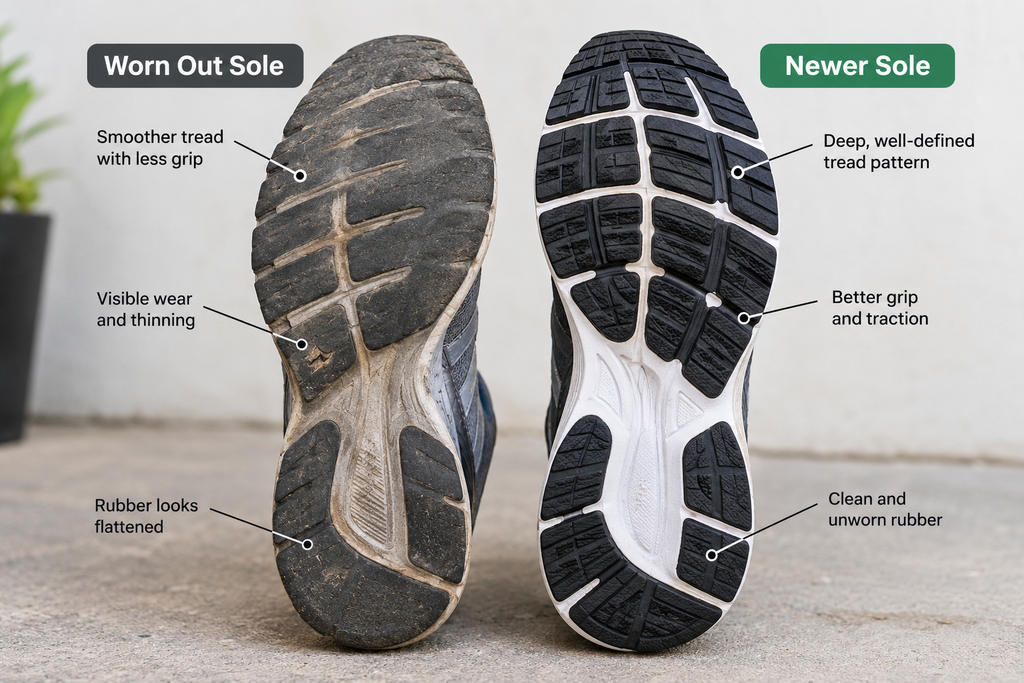
1. The Outsole Is Heavily Worn
The outsole is the part of the shoe that comes into direct contact with the ground.
Over time, the rubber can become smooth or uneven, particularly in the areas where your foot strikes the ground most often.
If the outsole has significant wear and you are losing traction, it may be time to consider a replacement.
2. The Cushioning Feels Flat
One of the biggest reasons people buy running shoes is cushioning.
If your shoes used to feel comfortable and responsive but now feel noticeably flat or hard, the midsole may have lost some of its original performance.
You might notice this especially after longer runs.
A shoe does not necessarily need to look damaged on the outside before its cushioning begins to deteriorate.
3. You Start Feeling More Foot or Leg Discomfort
A change in how your body feels during or after running can be another warning sign.
For example, you may notice that your feet, ankles, knees, or legs feel more tired than usual when using an older pair.
This does not automatically mean your shoes are responsible. Running discomfort can have many causes, including training changes, running technique, recovery, or other factors.
However, if the discomfort consistently appears when using an old pair of shoes, checking the condition of the shoes is worthwhile.
4. The Midsole Shows Visible Creasing or Compression
Look at the foam section between the outsole and upper.
If the midsole has deep creases, compressed areas, or appears noticeably uneven compared with when the shoes were new, it may indicate that the cushioning material has experienced significant wear.
Some creasing is completely normal. The important thing is whether the foam looks heavily compressed or uneven.
5. The Shoes Feel Uneven
Put your shoes on a flat surface and look at them from behind.
Do they appear to lean to one side?
Excessive uneven wear can change the way the shoe sits under your foot.
You can also inspect the outsole to see whether one side has worn down significantly more than the other.
If the shoes feel noticeably uneven while running, replacing them may be worth considering.
6. The Upper Is Damaged
The upper is the material that holds your foot inside the shoe.
Small marks or minor wear do not necessarily mean you need new shoes. But large tears, broken stitching, damaged eyelets, or a loose heel area can affect how securely the shoe holds your foot.
If your foot moves around more than it used to because the upper has deteriorated, the shoes may have reached the end of their useful life.
7. Your Running Shoes Have Become Uncomfortable
Sometimes the simplest warning sign is the most important: your shoes no longer feel good to run in.
Running shoes should provide a comfortable and secure fit.
If the same shoes that once felt great now feel hard, unstable, loose, or uncomfortable, inspect them carefully.
Your feet can also change over time, so an uncomfortable fit does not always mean the shoe is worn out. You may simply need a different size, shape, or type of running shoe.
Does Running Shoe Mileage Really Matter?
Yes, but mileage should not be the only thing you consider.
A pair of running shoes that has covered 500 km is not automatically finished, just as a pair with only 300 km is not automatically in perfect condition.
Mileage is best used as a reminder to inspect your shoes.
For example, once your shoes have accumulated several hundred kilometres, start paying closer attention to:
- Cushioning
- Outsole wear
- Midsole compression
- Stability
- Comfort
- Upper damage
The condition of the shoe should ultimately help guide your decision.
How Can You Make Running Shoes Last Longer?
You cannot make running shoes last forever, but good habits can help you get more useful wear from them.
1. Use Them Mainly for Their Intended Purpose
If you have a dedicated pair of running shoes, try not to use them for every activity.
Walking, gym workouts, casual wear, and running all place different demands on footwear.
Keeping a running shoe primarily for running can help you track its actual running mileage more accurately.
2. Let Your Shoes Dry Properly
If your shoes become wet after rain or heavy sweating, allow them to dry naturally before wearing them again.
Avoid exposing them to excessive direct heat, which can affect some shoe materials and adhesives.
3. Keep Them Clean
Dirt and mud can build up around the outsole and upper.
Regularly removing dirt with an appropriate cleaning method can help keep your shoes in better condition.
4. Avoid Using Worn-Out Shoes for Important Runs
If you are preparing for a long-distance race or an important training session, you do not want to discover that your shoes are uncomfortable halfway through the run.
Check your shoes regularly and replace them when their condition or comfort indicates that they are no longer suitable.
How Do You Know If Your Running Shoes Are Still Good?
Before buying a new pair, inspect your current shoes.
Ask yourself:
Does the outsole still have good traction?
Does the cushioning still feel comfortable?
Does the shoe feel stable when I run?
Is the upper still holding my foot securely?
Does one side look significantly more worn than the other?
Have I noticed a major change in how the shoes feel?
If several answers raise concerns, it may be time to start looking for a replacement.
Should You Replace Running Shoes Based Only on Their Age?
Not necessarily.
A pair of running shoes that has been sitting in your wardrobe for a long time may have very little running mileage, while another pair that you use several times a week may wear out much sooner.
Age is therefore only one part of the equation.
How frequently the shoes are used and how they have been stored also matter.
Final Thoughts
So, how long do running shoes last?
For many runners, around 480 to 800 km is a useful general guideline, but there is no universal replacement point.
The most important thing is to pay attention to the condition and performance of your shoes.
Heavy outsole wear, compressed cushioning, uneven wear, damaged uppers, and a noticeable decline in comfort are all signs that you should inspect your running shoes and consider replacing them.
A running shoe does not have to look completely destroyed before it has reached the end of its useful life.
Looking for more footwear guides? Follow CAEKICKS for practical sneaker and footwear tips to help you choose, wear, and care for your shoes.