

Walking on concrete for several hours can be harder on your feet than walking on softer surfaces. Concrete provides very little natural shock absorption, so the sneakers you choose can make a noticeable difference in comfort.
Whether you work in a warehouse, hospital, store, factory, school, or simply spend a lot of time walking around a city, choosing the right footwear matters.
The best sneakers for walking on concrete should combine cushioning, support, stability, durability, and a comfortable fit. But you don’t necessarily need the most expensive pair. You need a sneaker that matches your feet and how you use it.
In this guide, we’ll look at what to consider when choosing comfortable sneakers for concrete floors and highlight some of the best options worth considering in 2026.

What Makes a Good Sneaker for Walking on Concrete?
Not every comfortable sneaker performs well on hard surfaces. Concrete can increase the impact your feet experience with every step, especially when you’re walking for several hours.
Here are the main features to look for.
1. Good Cushioning
Cushioning is one of the most important features when choosing sneakers for concrete.
A well-cushioned midsole can help absorb some of the impact created when your foot hits a hard surface.
Look for sneakers with responsive foam or other cushioning technologies that provide comfort without feeling excessively soft or unstable.
2. Adequate Arch Support
Arch support can help provide a more stable platform for your feet.
However, the amount of support you need depends on your individual foot shape. Some people prefer a more supportive shoe, while others are comfortable with a relatively neutral design.
If you regularly experience discomfort while walking, don’t assume that more arch support is automatically better. Finding the right fit is more important.
3. A Stable Heel
Your heel should feel secure inside the sneaker.
A firm heel counter can help prevent excessive movement and make the shoe feel more stable when you’re walking across hard surfaces.
A shoe that allows your heel to slide around can become uncomfortable during long periods of walking.
4. Durable Outsole
Concrete can be abrasive.
A sneaker with a durable rubber outsole can potentially last longer when regularly used on hard surfaces.
Pay attention to the outsole pattern as well. Good traction is useful if you’re moving between different surfaces throughout the day.
5. Comfortable Fit
Even a highly cushioned sneaker won’t feel good if the fit is wrong.
Your toes should have enough room to move naturally without your foot sliding around inside the shoe.
When trying on sneakers, consider wearing the type of socks you normally use. It’s also worth trying them later in the day, when your feet may be slightly swollen.
7 Best Sneakers for Walking on Concrete in 2026
There isn’t one perfect sneaker for everyone. Your choice should depend on your foot shape, walking habits, budget, and preferred level of cushioning.
Here are seven models worth considering.
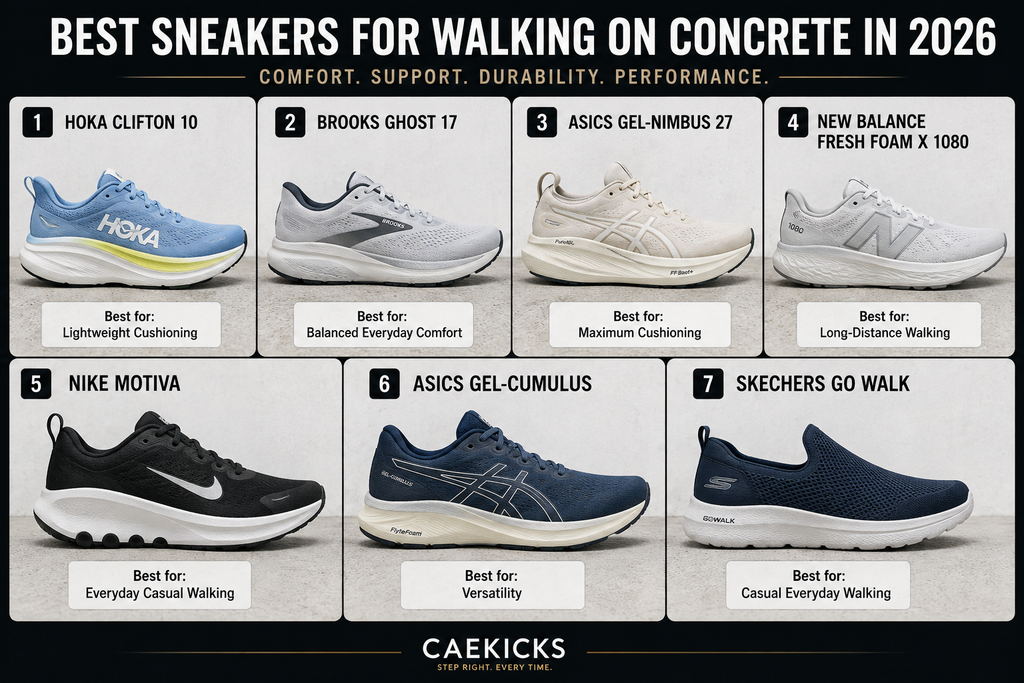
1. Hoka Clifton 10
The Hoka Clifton 10 is designed around a cushioned, lightweight running-shoe platform.
Its substantial midsole makes it an interesting option for people who want a soft and comfortable ride while walking on hard surfaces.
Best for: People who prioritize lightweight cushioning.
2. Brooks Ghost 17
The Brooks Ghost line has long been popular among people looking for a comfortable everyday running and walking shoe.
The Ghost 17 provides a balanced combination of cushioning and stability, making it suitable for everyday use on hard surfaces.
Best for: Everyday walking and people who prefer balanced cushioning.
3. ASICS GEL-Nimbus 27
The GEL-Nimbus 27 focuses heavily on cushioning and comfort.
Its cushioned construction makes it worth considering if you’re particularly sensitive to the feel of hard surfaces beneath your feet.
Best for: Maximum cushioning and comfort.
4. New Balance Fresh Foam X 1080
The Fresh Foam X 1080 series is another option for people who prefer a soft, cushioned walking experience.
The combination of cushioning and a comfortable upper makes it suitable for everyday walking and longer periods on hard surfaces.
Best for: Long walks and everyday comfort.
5. Nike Motiva
The Nike Motiva was designed with walking and everyday movement in mind rather than traditional running alone.
Its distinctive rocker-shaped sole encourages a smoother transition from heel to toe.
Best for: Casual walking and everyday movement.
6. ASICS Gel-Cumulus
The Gel-Cumulus provides a more balanced cushioning experience than some highly cushioned models.
It’s a versatile choice for people who want a sneaker that can handle walking, everyday activities, and occasional running.
Best for: Versatility.
7. Skechers GO WALK
Skechers GO WALK models are designed with everyday walking in mind and are often chosen for their lightweight construction and comfort.
They’re particularly worth considering if your priority is casual walking rather than athletic performance.
Best for: Casual everyday walking.
Best Sneakers for Different Needs
| Need | Recommended Option |
|---|---|
| Lightweight cushioning | Hoka Clifton 10 |
| Balanced everyday comfort | Brooks Ghost 17 |
| Maximum cushioning | ASICS GEL-Nimbus 27 |
| Long-distance walking | New Balance Fresh Foam X 1080 |
| Everyday casual walking | Nike Motiva |
| Versatility | ASICS Gel-Cumulus |
| Casual comfort | Skechers GO WALK |
Are Running Shoes Good for Walking on Concrete?
Yes. Running shoes can be excellent for walking on concrete.
Many running shoes are designed with cushioning, shock absorption, stability, and durable outsoles, which can also be useful for people who walk frequently on hard surfaces.
However, a running shoe isn’t automatically the right choice.
Some running shoes are designed for speed and performance rather than prolonged casual walking. Others may have aggressive designs that aren’t particularly comfortable for everyday use.
The important thing is to evaluate the cushioning, stability, fit, flexibility, and outsole rather than choosing a shoe simply because it is labeled as a running shoe.
What About Sneakers for Walking on Concrete All Day?
If you’re walking on concrete for most of your workday, comfort becomes even more important.
Consider these features:
- Cushioned midsole
- Comfortable upper
- Secure heel
- Breathable materials
- Adequate toe room
- Durable outsole
- Good traction
- Reasonable weight
You should also consider whether your workplace requires specific safety features. A comfortable running sneaker may not be appropriate for environments that require protective footwear.
How to Make Your Sneakers More Comfortable on Concrete
Even a good sneaker can become uncomfortable if it’s worn incorrectly or becomes excessively worn.
Replace Worn-Out Insoles
If the rest of your sneaker is still in good condition, replacing the removable insole may improve comfort.
Choose an insole that fits the shoe properly and doesn’t make the toe box excessively tight.
Wear Appropriate Socks
Socks can make a surprisingly large difference.
Look for comfortable, moisture-managing socks that aren’t excessively thick or tight.
Rotate Your Sneakers
If possible, avoid wearing the exact same pair every day.
Rotating between two pairs gives each pair time to air out and allows the cushioning materials to recover between uses.
Pay Attention to Wear
Look at the outsole regularly.
If one area is significantly more worn than another, the sneaker may no longer provide the same level of stability and traction it had when new.
How Long Do Sneakers Last on Concrete?
There isn’t a universal replacement schedule.
Someone who walks several miles every day on concrete may wear through a sneaker considerably faster than someone who only wears the same pair occasionally.
Instead of relying solely on a specific number of months, look for signs of deterioration.
Replace your sneakers when you notice:
- Flattened or compressed cushioning
- Excessive outsole wear
- Uneven tread
- Damaged upper material
- Reduced stability
- Persistent discomfort
- Visible structural breakdown
The surface you’re walking on is also important. Frequent walking on concrete can place considerable demands on the outsole and midsole.
How to Choose the Right Size
Getting the right size is just as important as choosing the right model.
When shopping for sneakers:
- Measure both feet.
- Choose the size that accommodates your larger foot.
- Leave some space between your longest toe and the front of the shoe.
- Make sure your heel doesn’t slip excessively.
- Walk around before purchasing.
- Pay attention to pressure points.
Remember that sizing can vary between brands and even between different models from the same brand.
Don’t rely exclusively on the size printed on your old sneakers.
Final Thoughts
The best sneakers for walking on concrete should provide a combination of cushioning, stability, durability, traction, and a comfortable fit.
Models such as the Hoka Clifton 10, Brooks Ghost 17, ASICS GEL-Nimbus 27, New Balance Fresh Foam X 1080, Nike Motiva, ASICS Gel-Cumulus, and Skechers GO WALK are worth considering, but the best choice ultimately depends on your feet and how you plan to use the sneaker.
Most importantly, don’t choose footwear based on appearance alone.
If you’re walking on concrete for hours every day, prioritize comfort, support, cushioning, and durability. A sneaker that feels good for five minutes in a store isn’t necessarily the sneaker that will feel good after several hours of walking.